Modern vehicles are smarter than ever before.
Features like automatic emergency braking, lane departure warning, adaptive cruise control, blind spot monitoring, and forward collision alerts help keep drivers safer every day.
But what many vehicle owners don't realize is that these safety systems rely on cameras, sensors, and radar equipment that must be precisely calibrated after an accident.
At Hollywood Collision Center, we perform ADAS calibrations in-house to help ensure your vehicle's advanced safety systems are functioning properly before it returns to the road.
What Does ADAS Mean?
ADAS stands for Advanced Driver Assistance Systems.
These systems use cameras, sensors, radar, and computers to monitor the vehicle's surroundings and assist the driver.
Common ADAS features include:
Automatic Emergency Braking (AEB) Adaptive Cruise Control Lane Keep Assist Lane Departure Warning Blind Spot Monitoring Rear Cross Traffic Alert Parking Sensors 360-Degree Cameras Forward Collision Warning Traffic Sign Recognition
Today, most newer vehicles from manufacturers like Honda, Toyota, Nissan, Hyundai, Kia, Mazda, Ford, Chevrolet, and Tesla come equipped with some form of ADAS technology.
Why Does ADAS Need Calibration?
After a collision, even a minor one, cameras and sensors can move slightly out of position.
The problem?
A sensor that's off by just a few millimeters can impact how the vehicle interprets what's happening around it.
Without proper calibration:
Emergency braking may activate too late Lane assist may drift incorrectly Adaptive cruise control may misjudge distance Blind spot systems may become inaccurate Collision warning systems may not perform properly
In other words, your vehicle may no longer provide the protection it was designed to deliver.
When Is ADAS Calibration Required?
Many drivers assume calibration is only needed after a major accident.
That's not true.
ADAS calibration may be required after:
Collision Repairs
Even minor front or rear impacts can affect sensor alignment.
Windshield Replacement
Many forward-facing cameras are mounted to the windshield.
Suspension Repairs
Changes to ride height can affect camera angles and radar measurements.
Wheel Alignments
Certain manufacturers require recalibration after alignment procedures.
Bumper Replacement
Many radar sensors are located behind front and rear bumpers.
Static vs Dynamic Calibration
There are two primary types of ADAS calibration:
Static Calibration
Performed inside the repair facility using specialized targets, measuring equipment, and manufacturer procedures.
Dynamic Calibration
Performed while driving the vehicle under specific road conditions.
Some vehicles require one method, while others require both.
Why Proper Calibration Matters
Vehicle manufacturers spend thousands of engineering hours designing safety systems to protect drivers and passengers.
Failing to properly calibrate these systems after repairs can compromise their effectiveness.
That's why professional collision repair facilities follow manufacturer repair procedures and use specialized calibration equipment.
Proper calibration helps ensure:
✅ Safety systems function as intended
✅ Manufacturer standards are met
✅ Repairs are completed correctly
✅ Driver confidence is restored
Hollywood Collision Center Performs ADAS Calibrations In-House
One of the advantages of choosing Hollywood Collision Center is that we perform ADAS calibrations right here at our facility.
Many body shops must outsource calibrations to third-party vendors, creating delays and additional vehicle transportation.
Our in-house capabilities help us:
Improve repair efficiency Maintain quality control Reduce delays Verify proper system operation before delivery Don't Overlook This Critical Safety Step
Your vehicle's safety systems are designed to protect you when every second matters.
After an accident, replacing parts is only part of the repair process.
Making sure those advanced safety systems are calibrated correctly is just as important.
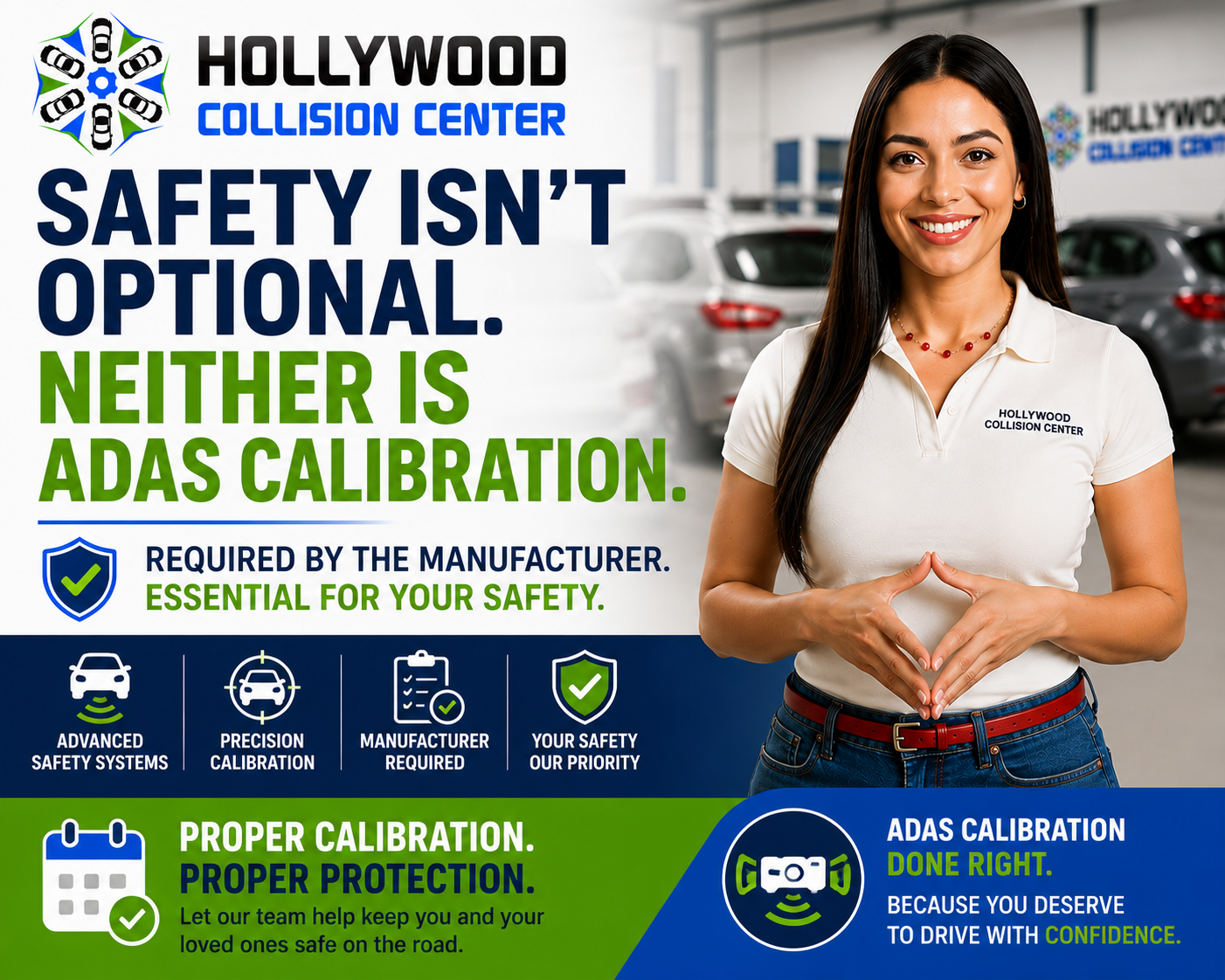
ADAS Calibration Isn't Optional — It's Required by the Manufacturer
One of the biggest misconceptions after a collision repair is that ADAS calibration is an "extra" service.
It isn't.
Vehicle manufacturers such as Honda, Acura, Nissan, Infiniti, Mazda, Kia, Hyundai, Toyota, Lexus, Ford, Chevrolet, and many others require ADAS calibration whenever certain repairs are performed.
Manufacturer repair procedures may require calibration after:
Collision repairs Windshield replacement Bumper replacement Suspension repairs Wheel alignments Sensor replacement Camera replacement
Even if a sensor appears undamaged, manufacturers often require recalibration to verify the system is operating within factory specifications.
Skipping this critical step can result in:
Inaccurate emergency braking performance Blind spot monitoring errors Improper lane keeping assistance Forward collision warning malfunctions Reduced effectiveness of vehicle safety systems
That's why reputable collision repair facilities follow OEM (Original Equipment Manufacturer) repair procedures—not shortcuts.
At Hollywood Collision Center, ADAS calibration is performed according to manufacturer requirements to help ensure your vehicle's advanced safety systems operate as intended after repairs are completed.
Why Choosing the Right Collision Center Matters
Not all body shops have the equipment, training, or capability to perform manufacturer-required ADAS calibrations.
At Hollywood Collision Center, we perform ADAS calibrations in-house and follow OEM repair procedures because your safety depends on it.
When you choose Hollywood Collision Center, you're choosing a repair facility that understands modern vehicle technology and the importance of restoring your vehicle to manufacturer standards—not just making it look repaired.
Your vehicle may look repaired when the body work is complete. It isn't truly repaired until the safety systems are properly calibrated.