After a car accident, most drivers are focused on getting their vehicle repaired safely and getting back on the road. But once you receive the repair estimate, you may notice terms such as OEM parts or aftermarket parts.
What do those terms mean? Does it matter which parts are used? And does your insurance company have the final say?
For drivers in Hollywood, Fort Lauderdale, Davie, Pembroke Pines, Miramar, and throughout Broward County, understanding the difference can help you make more informed decisions about your collision repair.
What Are OEM Parts?
OEM stands for Original Equipment Manufacturer.
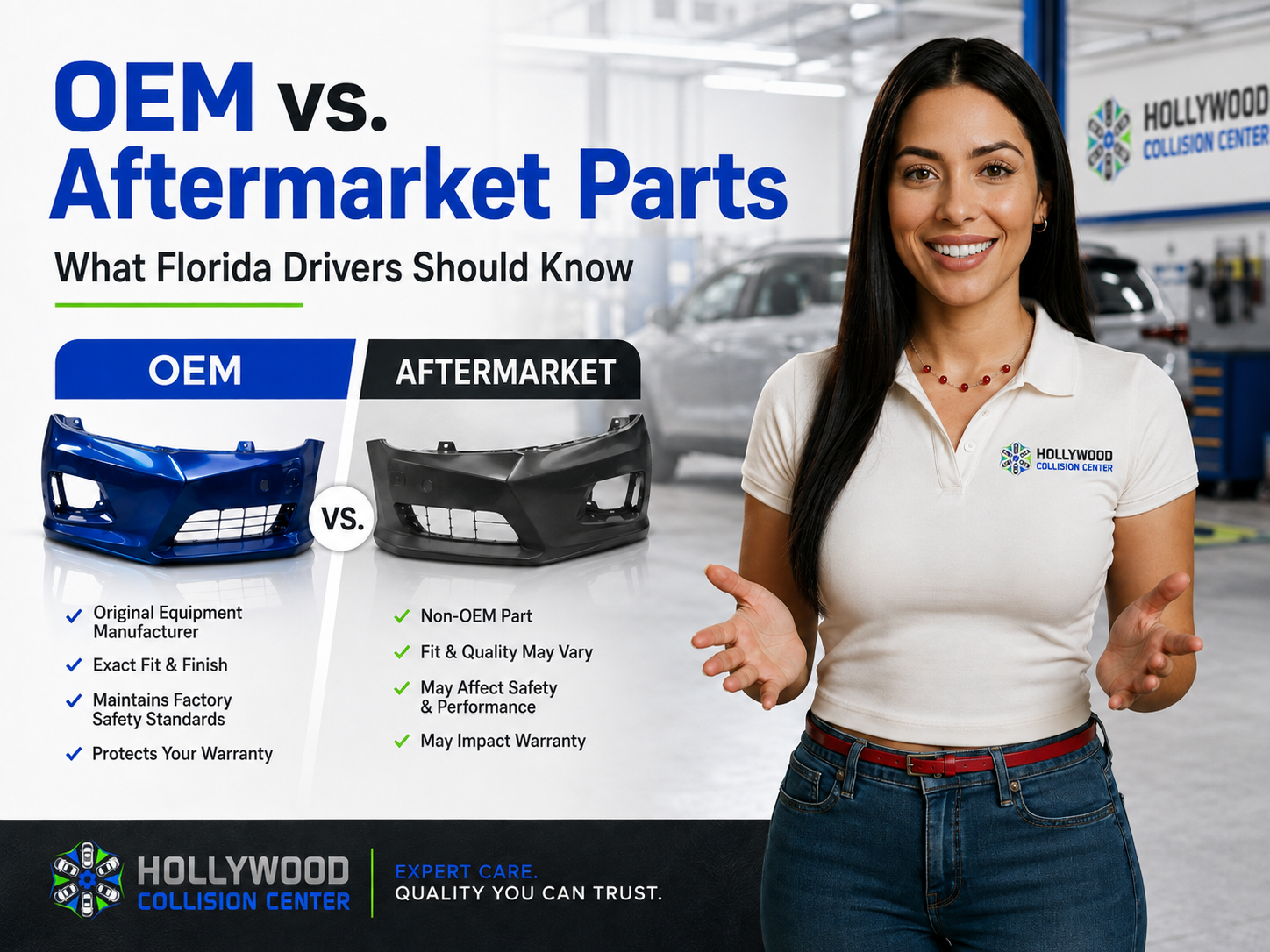
OEM parts come from your vehicle's manufacturer or its approved supplier and are designed specifically for your year, make, and model.
For example, if your Honda needs a new bumper after an accident, an OEM Honda replacement part is designed according to the manufacturer's specifications for that particular vehicle.
OEM parts are typically valued for:
* Vehicle-specific fit and finish * Compatibility with surrounding factory components * Manufacturer specifications * Consistency with OEM repair procedures * Integration with today's increasingly complex vehicle technology
This can be particularly important on newer vehicles, where bumpers, mirrors, grilles, windshields and other components may be located near cameras, radar sensors or other parts of an Advanced Driver Assistance System (ADAS)
What Are Aftermarket Parts?
Aftermarket parts are replacement parts manufactured by a company other than the original vehicle manufacturer or its supplier.
In collision repair, these may include exterior components such as bumper covers, fenders, hoods, body panels and other plastic or sheet-metal parts.
Aftermarket parts can cost less than OEM parts, which is one reason they may appear on an insurance company's repair estimate.
That does not automatically mean an aftermarket part is a bad part. Quality can vary significantly between manufacturers and individual components. The important question is whether the replacement part is appropriate for the vehicle and the repair being performed.
#What Does Florida Law Say About Aftermarket Parts?
Florida has specific consumer protections regarding aftermarket crash parts.
Under Florida's Aftermarket Crash Parts Act, if non-OEM aftermarket crash parts are included in a repair estimate, those parts must be clearly identified on the written estimate. Florida law also requires a disclosure explaining that those aftermarket parts are warranted by the part manufacturer or distributor rather than by the manufacturer of your vehicle.
Florida insurance law also states that an insurer may not require replacement parts that are not at least equivalent in kind and quality to the damaged parts that existed before the loss in terms of fit, appearance and performance.
However, this does not necessarily mean your insurance policy is required to pay for OEM parts in every repair. Coverage and parts provisions can vary from one insurance policy and claim to another.
That is why it is important to understand what is actually included on your estimate.
## Look Closely at Your Collision Repair Estimate
Many drivers understandably focus on the number at the bottom of an insurance estimate.
But the parts listed on the estimate matter too.
If your vehicle has been involved in an accident, look for descriptions indicating whether replacement parts are:
* OEM * Aftermarket or non-OEM * Recycled or previously used OEM * Reconditioned or remanufactured
If you don't recognize an abbreviation or aren't sure what type of part has been specified, ask your collision repair shop to explain it before repairs begin.
A quality body shop should be willing to walk you through the estimate rather than expecting you to understand collision-industry terminology on your own.
Why Part Selection Matters on Modern Vehicles
Today's vehicles are much more sophisticated than they were even a decade ago.
What looks like a simple bumper replacement can involve cameras, radar sensors, mounting brackets, wiring, impact components and manufacturer-specific repair procedures.
Many vehicles also require ADAS calibration after collision repairs so safety features such as forward collision warning, adaptive cruise control, blind spot monitoring or lane assistance can operate as designed.
This is one reason choosing a collision center with proper training and equipment matters just as much as choosing the parts themselves.
Hollywood Collision Center holds seven industry and manufacturer certifications, including I-CAR Gold Class along with manufacturer certifications for Mazda, Honda, Kia, Infiniti and Nissan. Our technicians receive vehicle-specific training and follow manufacturer repair procedures when repairing today's advanced vehicles.
OEM Isn't Always the Only Question to Ask
When discussing parts with your collision repair shop, consider asking:
What type of part is listed on my estimate? Know whether the estimate calls for OEM, aftermarket or another type of replacement part.
Why is this particular part being recommended? Part selection can depend on your vehicle, the location of the damage, availability, insurance coverage and manufacturer repair requirements.
Will this part work properly with my vehicle's technology? This is especially important when the repaired area contains or is located near ADAS components.
Are manufacturer procedures being followed? A proper collision repair is about much more than making the exterior of the vehicle look good again.
Will my vehicle require calibration after the repair? Depending on the damage and repairs performed, ADAS systems may need to be inspected and calibrated.
Your Insurance Estimate Is the Beginning of the Repair Process
An insurance estimate is an important part of the claim, but it does not physically disassemble and inspect your vehicle.
Once repairs begin, the collision center can determine exactly what is required to restore the damaged areas properly.
At Hollywood Collision Center, we work directly with major insurance companies and help customers understand the repair process, documentation and next steps. Our collision repair process includes inspection, insurance coordination, structural and body repairs, refinishing, calibration when required and a final quality inspection.
Choosing the Right Collision Repair Shop in Hollywood, FL
Whether your estimate calls for OEM or aftermarket parts, one of the most important decisions you can make after an accident is choosing a repair facility that understands your vehicle.
Look for a collision center that:
* Has current industry and manufacturer certifications * Uses proper repair procedures * Can explain the parts listed on your estimate * Understands modern ADAS technology * Communicates directly with your insurance company * Is transparent about the repair from beginning to end
At Hollywood Collision Center, our goal is to help South Florida drivers understand what is happening with their vehicle—not leave them guessing.
If you've been in an accident in Hollywood, Fort Lauderdale, Davie, Pembroke Pines, Miramar or anywhere in Broward County, bring us your insurance estimate or send us photos through our Virtual Estimate tool. Our team can review your vehicle and help explain the collision repair process.
Hollywood Collision Center 6030 Cleveland St. Hollywood, FL 33024 (954) 616-8540
Need collision repair? Request a Virtual Estimate or schedule an appointment with Hollywood Collision Center today.